Your colleagues have expertise in how to work with AI. OpenTacit turns that expertise into knowledge that you can use at the moment you need it, with proof that it works.
AI models get more capable every day. But people do not use a new ability when they do not know that it exists. This gap between what a model can do and what its users try has a name: the "technique overhang".
No model has seen your organization's own data, systems, or conventions, not even the best model. Thus a person must fill that gap. Your best AI users can share what they have learned. But this must not cost them their own time.
OpenTacit solves this problem.
The loop
You work as usual in your AI coding tool: Claude Code, Codex, Gemini CLI, GitHub Copilot CLI, Cursor, Amp, pi, omp, or opencode. OpenTacit calls this tool your harness. While you work:
- A small local agent examines each completed turn. It identifies the type of task you do.
- It asks your organization's shared registry if a validated technique from your organization's playbook matches your task.
- If a technique matches, OpenTacit offers it in your session, below the answer you read. OpenTacit includes the measured evidence, for example "helped 94% · n=120."
- Feedback goes back to the registry: if you adopted the suggestion, and if it helped. The evidence improves. The next suggestion also improves.
This loop does not need you to change how you work. OpenTacit observes, offers, and measures. You keep control.
Techniques and the playbook
The unit of knowledge is a technique: one validated move, with a written description that lets another person use it. Together, your organization's techniques form its playbook: the measured memory of what works with AI. A technique contains:
- Name and description — what the move is
- Recipe — the concrete steps to apply it
- Applies when / not when — the situations that it fits, and the situations that it does not fit
- Tags and task types — how OpenTacit categorizes and matches it
- Outcomes — the measured evidence: how many times members saw it, adopted it, and got help from it
OpenTacit always shows a technique's evidence as measured, for example "measured by colleagues: helped 94% · n=120". If nobody has tried the technique, OpenTacit shows "awaiting measured outcomes". OpenTacit never invents evidence.
The life of a technique
Techniques enter the registry as drafts. A draft has one of four sources: a member contribution, a proposed revision, a research pass, or an import from another organization. Retrieval does not serve a draft to anyone until a reviewer promotes it on the Review page. After promotion, the technique serves, gathers evidence, and stays accountable to that evidence. If a technique's recent results fall below its own baseline, OpenTacit flags it as decaying and puts it in the queue for revalidation. You can retire a technique that no longer gets good results. You can restore a retired technique later if it is necessary again.
Scope
Every technique is general (good practice in all places) or org-scoped (specific to how your organization works). Org-scoped techniques show an org badge in all parts of the dashboard.
Evidence
Feedback drives everything. OpenTacit records four stages:
| Stage | Meaning |
|---|---|
| Shown | A member saw the technique: a push suggestion, or the one technique that an @tacit answer cites. A search of the playbook does not count |
| Adopted | The member acted on it, and there is proof |
| Helped | It improved the outcome, and OpenTacit measured this |
| Dismissed | The member declined it, with a reason |
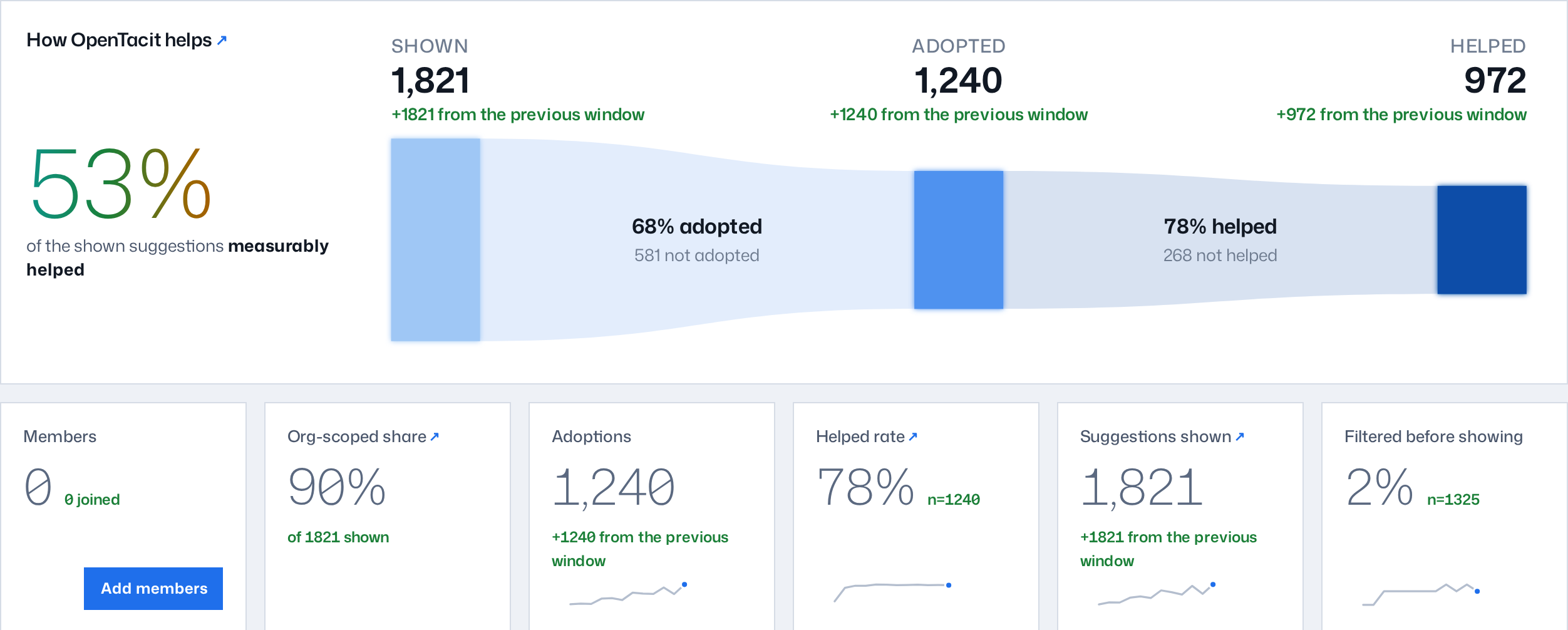
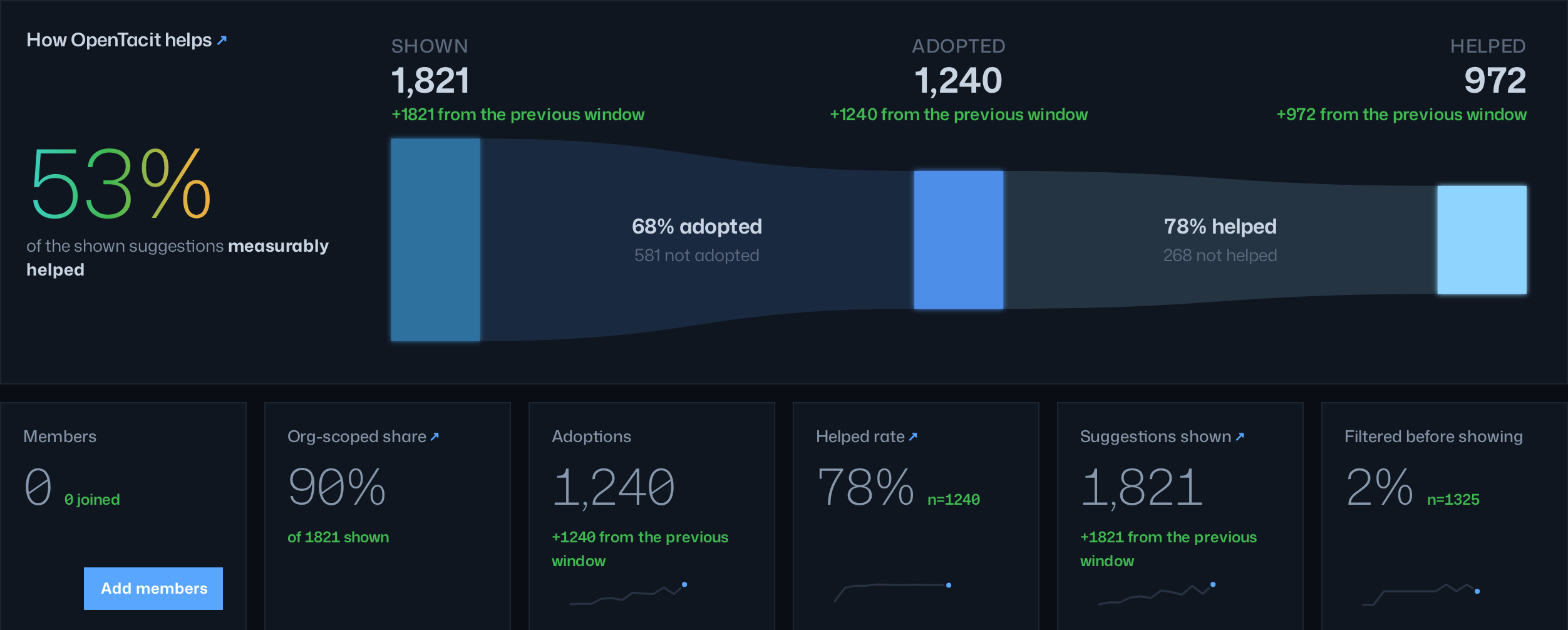
OpenTacit captures most feedback automatically from what you do and say. You rarely need to record it yourself. See Give feedback.
Cohorts, never identities
The registry stores outcomes by cohort: aggregate dimensions such as team, role, and harness. The registry never stores who did what. This is intentional. Your personal record of the suggestions that you adopted or dismissed stays in a file on your own machine. The file stays on your machine only. Each report about "who" is about cohorts, never about individual persons. Reports show where knowledge has room to spread. Reports do not rank people. See the privacy notes in Join your organization's registry and Give feedback.
The three surfaces
- Your session — suggestions arrive during your work; slash commands such as
/tacit:searchand/tacit:contributeoperate on demand. - The dashboard — the registry's web app: Outcomes, Playbook, and Review, plus administration.
- The command line — the single
tacitbinary sets up, connects, diagnoses, and serves everything.
The next two chapters make OpenTacit operational for you. Set up a registry if your organization does not have one. Or join the registry it has.