Review is the page where a person makes decisions at regular intervals. All items that wait for you are on this page:
- Drafts to promote or reject
- Techniques under evaluation in the shadow lane
- Techniques with evidence that decays
- Techniques that members see but do not adopt
The badge on Review in the top bar counts the items that wait. When the page shows no items, no work remains.
Tip: Draft decisions do not need the dashboard. The command /tacit:drafts in a session runs the same queue. The queue shows as an interactive panel, a native form, or a conversation. The type depends on your client. See Search and review on demand.
Each section below has a count in the queue line at the top of the page. Click a count to go to its section.
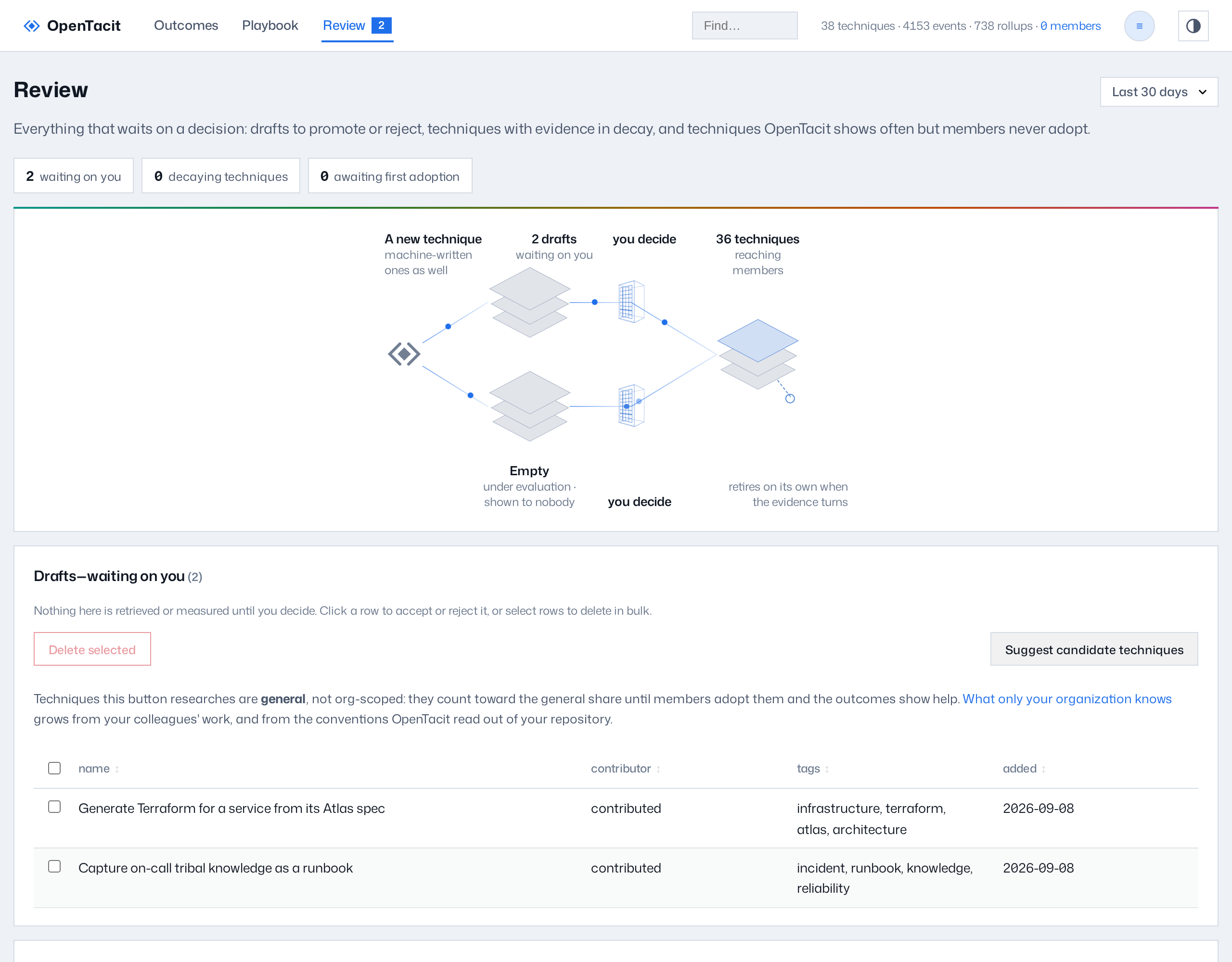
Decide on drafts
Each draft waits here, with the newest first. Drafts come from these sources:
- A member contributed it.
- A person proposed it as a revision.
- A research pass filed it.
- An import from a different organization added it.
Each row shows the contributor, the tags, and the date of addition. Sort by a column, or use the filter box to decrease the list.
To review one draft:
- Click the row of the draft.
- Read the technique. For a revision, the page also shows the technique that it replaces, the note of the proposer, and a field-by-field diff against the current technique.
- If the draft needs work, edit it in place. You can edit the name, description, recipe, applies when, not when, and tags. Then click Save edits.
- Click Accept to put the draft in service. Or click Reject to refuse it.
A promoted technique goes into service immediately and starts to collect evidence. The registry keeps a rejected draft. It does not erase it. You can remove drafts fully, for example spam or the results of a bad research pass. Select their checkboxes in the list. Then click Delete selected. You must confirm the deletion. Deletion applies only to drafts. You cannot undo a deletion.
Techniques under evaluation
The shadow lane is between draft and live. In this lane, the fit-check scores a technique against real work and judges its relevance. But the system never shows the technique to a member. When a technique is in the lane, an Under evaluation section lists it.
This lane is different from the drafts above it. A draft is inert: the system does not retrieve it, does not fit-check it, and gathers no evidence about it. A draft moves only when a person moves it. A technique under evaluation is measured while it waits.
The section shows which of the two it is:
- Under evaluation — gathering evidence. Auto-promote is on. The section reports how far each technique is from the bar, for example
62% · 8 of 12 judged. Nothing here waits on you. A technique starts to serve on its own when it clears the bar, and retires on its own when it rarely fits. To decide one now instead of waiting, click the row to open the technique and use Accept or Reject there. - Under evaluation — waiting on you. Auto-promote is off, so nothing moves until you decide. Each row carries Accept and Reject.
Discover from usage — this button is at the bottom of the page. It collects the "worked moves" of members into clusters and makes new candidate techniques from them. The system files these techniques as observed and evaluates them in the shadow lane above. The process runs automatically when auto-discovery is on. The button runs the process immediately.
Ask for new drafts
Click Suggest candidate techniques to run a research pass. OpenTacit examines the usage profile of your organization. It finds practices that match the profile. It files a maximum of ten new drafts in this queue. The run takes one minute or more. A progress bar monitors the run. The page loads again with the new drafts when the run completes. The command /tacit:suggest runs the same pass in a session.
Researched candidates are general, not org-scoped. They count toward the general share of your playbook until members adopt them and the outcomes show help. The share that only your organization knows grows from what your colleagues use, not from the drafts that this button files. See Knowledge mix and health.
Two details of the run:
- A pass files fewer than ten drafts when it finds fewer usable ones. A safety screen refuses unsafe proposals, and OpenTacit discards a candidate that duplicates a technique that you have.
- One pass runs at a time. A second click joins the pass that runs, and does not start another. Nothing failed. Its drafts appear here when it completes. The pass continues on the server, so you can reload the page or leave it. The page shows the run again when you return.
Revalidate decaying techniques
This section flags a technique when its recent helped rate decreases below its own baseline. Thus the technique does not continue to serve on old evidence without a review. The table shows the baseline rate, the recent rate, and the time of the last check for each flagged technique. Click a row to see the decay curve and the full record. Your options are the curation actions from the technique's page:
- Revise the technique.
- Return it to drafts.
- Retire it.
Fix what's shown but never adopted
The last section is the retrieval worklist. It lists techniques that members see many times but do not adopt. The cause is a retrieval problem (incorrect technique, or incorrect moment) or a quality problem in the technique. In each case, a person must decide:
- Awaiting first adoption — members saw the technique in this window, but no member adopted it. Make the "applies when" of the technique more exact, adjust its tags, or retire it.
- Adopted, but shown far more often — the technique helps, but the system offers it too frequently. Usually the limits of the technique must become more narrow.